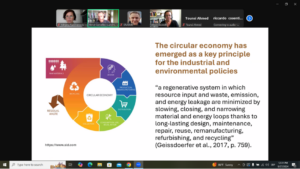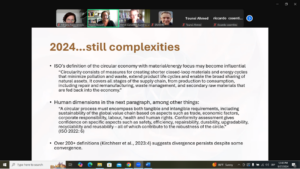

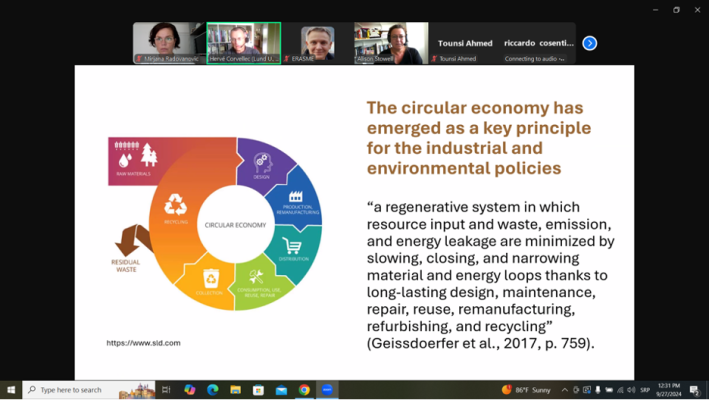

Alison Stowell (Lancaster University, United Kingdom) pointed out that problems in the implementation of the circularity model in the economy arise at the very beginning, because the definition itself is not clear, it is not clear to whom the ncircular model of the economy is intended, the concept of circularity is too broad and therefore without focus. It was pointed out that there are over 200 definitions of the circular economy.
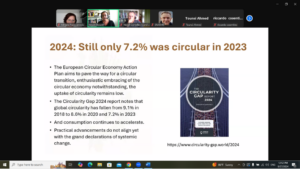
Hervé Corvellec (Lund University, Sweden) emphasizes that there are difficulties in understanding in the scientific community, as well as in practice. As a special problem, the unclear way to measure the effects of the transition to a circular model of the economy stands out. It is very possible that this is one of the important reasons why the European Union records a degree of circularity of only 7.2%.
The participants agreed that the stated result could objectively have been better, and it is necessary to further analyze the reasons for the above. The participants also pointed to the unclear impact of the application of the circular economy on society as a whole. Namely, it was pointed out that there was no adequate scientific (or any other) discussion on this sensitive issue.
Prof. Dr. Mirjana Radovanović briefly presented the project and participated in the discussion.